
Property Taxes in Nevada County, CA (2026): Prop 13, Supplemental Tax Bills, Prop 19 and Exemptions Explained

If you are buying a home in Grass Valley, Nevada City, Truckee, Penn Valley, Lake Wildwood or Lake of the Pines, property taxes will be one of your biggest ongoing costs. The good news: in California, the math is predictable once you know how it works.
This guide answers the property tax questions Nevada County buyers and sellers ask me most, using the county’s own 2026-27 tax rate file and California State Board of Equalization (BOE) rules. Every number below links to its source.
Key Takeaways: Nevada County Property Taxes, 2026
- The formula: your yearly tax is your assessed value times your area’s tax rate: a 1% base plus voter-approved bonds, plus any special taxes or direct charges.
- 2026-27 rates: Nevada County’s 162 non-utility tax rate areas ranged from 1.035201% to 1.069949% (Nevada County Auditor-Controller). The most common rate was 1.045819%.
- Due dates: first installment due November 1, delinquent after December 10; second installment due February 1, delinquent after April 10 (Nevada County Treasurer-Tax Collector).
- After you buy: the Assessor reassesses the home to market value as of the change in ownership, and you can get one or two supplemental tax bills (BOE).
- Prop 13: after that, the assessed value can rise by no more than 2% a year until the next sale or new construction (BOE).
- Save on taxes: the homeowners’ exemption cuts $7,000 from the taxable value of an owner-occupied home. Prop 19 lets eligible owners 55 or older, severely disabled owners and wildfire or disaster victims move their tax base to a new home anywhere in California.
How Is Property Tax Calculated in Nevada County?
California property tax starts with a 1% base rate on your assessed value. Proposition 13 lets local agencies add a rate to repay voter-approved bonds, and those add-on rates differ from area to area within a county, according to the BOE’s California Property Tax overview (Publication 29).
Nevada County is divided into tax rate areas (TRAs). Each TRA is a unique mix of city, school and special districts, and each has a six-digit number that appears on your tax bill. The BOE’s Nevada County tax rate area map lets you search an address to find its TRA.
What Is the Property Tax Rate in Nevada County for 2026?
The Nevada County Auditor-Controller’s Multi-Year Tax Rates 26-27 report (Tax Year 2026) lists every rate. Across the county’s 162 non-utility TRAs, the total rate ran from 1.035201% to 1.069949%. 77 TRAs had the most common rate, 1.045819%.
The differences come from school, college and hospital bonds. Here is what drives each group, based on the county’s rate file and its 2026/27 Tax Rate Area Chart:
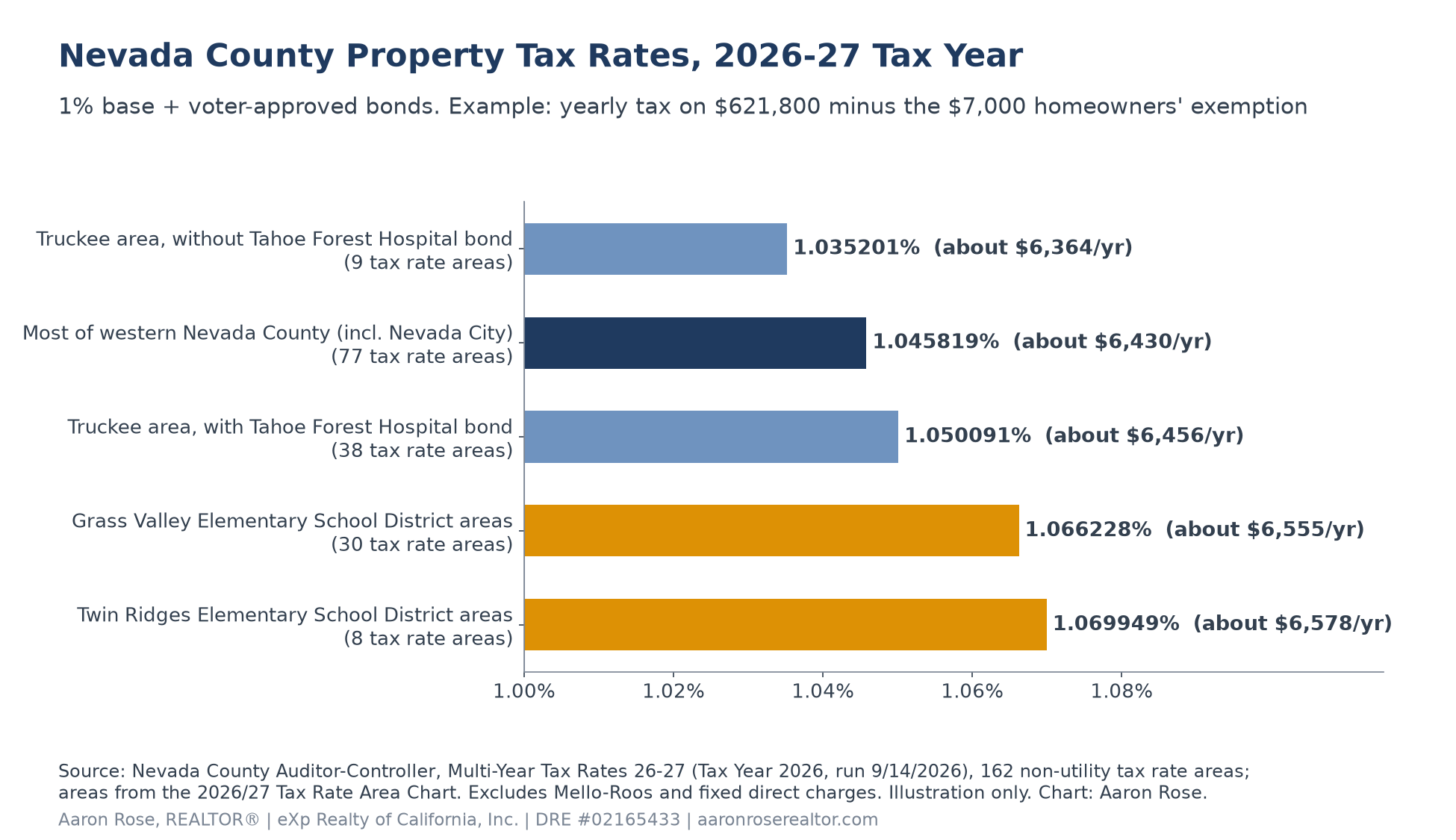
| Area group | Number of TRAs | Total rate | Voter-approved bonds on top of the 1% base | Example yearly tax* |
|---|---|---|---|---|
| Truckee area, without Tahoe Forest Hospital bond | 9 | 1.035201% | TTJUSD SFID #1 2014 (.027780); Sierra College SFID #1 2004 (.007421) | $6,364 |
| Most of western Nevada County (incl. Nevada City) | 77 | 1.045819% | Nevada Jt Union H.S. 2002 (.006847) and 2016 (.014985); Sierra College SFID #2 2004 (.023987) | $6,430 |
| Truckee area, with Tahoe Forest Hospital bond | 38 | 1.050091% | Tahoe Forest Hospital 2007 (.014890); TTJUSD SFID #1 2014 (.027780); Sierra College SFID #1 2004 (.007421) | $6,456 |
| Grass Valley Elementary School District areas | 30 | 1.066228% | Grass Valley Elem 2018 (.020409) plus the three western bonds | $6,555 |
| Twin Ridges Elementary School District areas | 8 | 1.069949% | Twin Ridges Elem 2024 (.024130) plus the three western bonds | $6,578 |
*Example only: ($621,800 minus the $7,000 homeowners’ exemption) times the rate. $621,800 is Nevada County’s median home value from the Census Bureau’s American Community Survey 2020-2024, not a sale price. Your bill also includes any special taxes and direct charges.
What Does That Mean for Grass Valley, Nevada City and Truckee?
- Nevada City: the city’s TRAs carried the 1.045819% rate in 2026-27.
- Grass Valley: city TRAs were at 1.045819% or 1.066228%. The higher rate applies inside the Grass Valley Elementary School District, which has a 2018 school bond.
- Truckee: town TRAs were at 1.035201% or 1.050091%, depending on whether the Tahoe Forest Hospital 2007 bond applies.
- Penn Valley, Lake Wildwood, Lake of the Pines and other unincorporated areas: rates depend on the TRA. Look up the parcel’s TRA number on the current bill or the BOE map, then match it in the county’s rate report.
Want a feel for each town first? See my Grass Valley neighborhood guide, Nevada City neighborhood guide and Penn Valley neighborhood guide, or my Grass Valley vs. Nevada City comparison.
What Else Can Show Up on a Nevada County Tax Bill?
The Auditor-Controller’s Property Tax Division places direct charges on the tax roll for local districts and accounts for special assessments. These are billed on top of the percentage rate, so two homes with the same value and TRA can still have different bills.
Some parcels also pay Mello-Roos special taxes to a Community Facilities District. Before you buy, look at the seller’s most recent tax bill line by line and ask what each charge is for.
How Do Census Numbers Compare Across Nearby Counties?
The Census Bureau asks homeowners what they pay in real estate taxes. In the American Community Survey 2020-2024 5-year estimates, the median Nevada County homeowner paid $4,694 a year, and the median home value was $621,800.
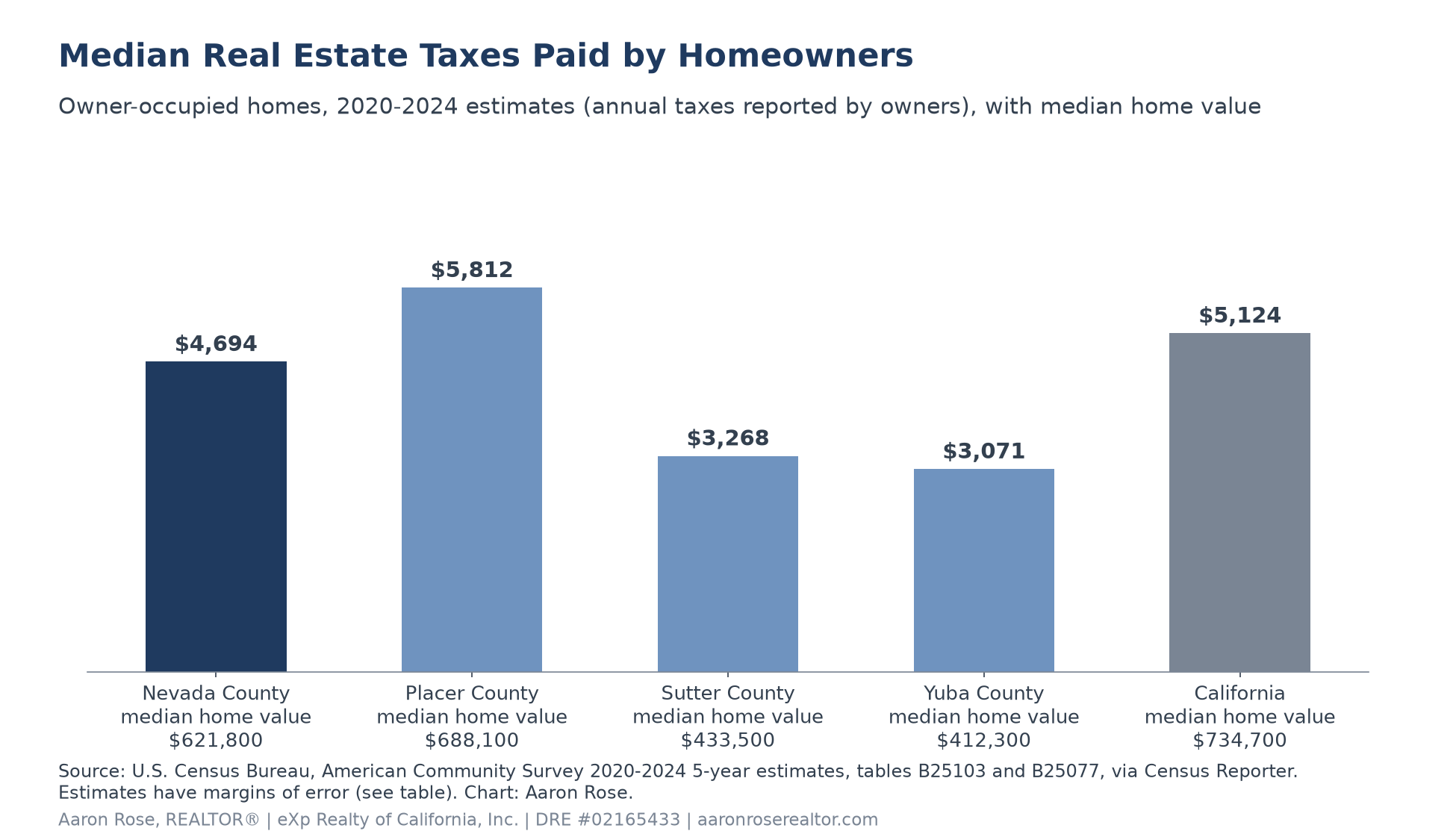
| Area | Median real estate taxes paid | Margin of error | Median home value | Margin of error |
|---|---|---|---|---|
| Nevada County | $4,694 | ±$162 | $621,800 | ±$12,667 |
| Placer County | $5,812 | ±$89 | $688,100 | ±$5,556 |
| Sutter County | $3,268 | ±$167 | $433,500 | ±$7,299 |
| Yuba County | $3,071 | ±$203 | $412,300 | ±$10,280 |
| California | $5,124 | ±$17 | $734,700 | ±$1,307 |
Why is the median tax paid lower than about 1.05% of the median home value? Prop 13 keeps assessed values for long-time owners well below today’s market value, so a recent buyer usually pays more than a neighbor who bought years ago. Use your purchase price, not these medians, to estimate your own bill. (Source: Census Reporter, table B25077.)
When Are Property Taxes Due in Nevada County?
The Nevada County Treasurer-Tax Collector mails bills in October to the mailing address on file with the Assessor. Taxes are paid in two installments:
| Installment | Due | Delinquent after |
|---|---|---|
| First | November 1 | December 10 |
| Second | February 1 | April 10 |
If a delinquent date falls on a weekend or holiday, the county says taxes are due the next business day. Online and phone payments count as on time until 11:59 p.m. on December 10 and April 10. E-checks are free, and the county charges a 2.38% convenience fee on card payments. Statewide, a late installment adds a 10% penalty, according to BOE Publication 29.
What Is a Supplemental Tax Bill?
When a home changes ownership or new construction is finished, the Assessor reassesses it to market value as of that date. A supplemental assessment covers the difference between the old and new value for the rest of the fiscal year, instead of waiting for the next January 1 lien date, according to BOE Publication 29.
- Buy between January 1 and May 31? Expect two supplemental bills: one for the rest of the current fiscal year and one for the entire next fiscal year.
- Value went down? A decrease in assessment results in a refund instead of a bill.
- Due dates vary. Supplemental bills mailed July 1 to October 31 follow the regular December 10 and April 10 dates. Bills mailed November 1 to June 30 have their own deadlines based on the mailing month.
- Plan for it. Ask your lender whether your impound account will cover supplemental bills, or set money aside.
How Does Prop 13 Limit Property Tax Increases?
Proposition 13 generally limits increases in a property’s base year value to no more than 2% a year, according to the BOE. The value resets to market value when the property changes ownership or new construction is completed.
That is why two similar homes on the same street can have very different tax bills. For buyers, the number that matters is your own purchase price, not the seller’s current bill.
What Is the Homeowners’ Exemption?
The California Constitution provides a $7,000 reduction in the taxable value of a qualifying owner-occupied home, according to the BOE’s homeowners’ exemption page. The home must be your principal residence on January 1, the lien date.
You file once with the county assessor on form BOE-266. First-time filers must file by February 15 to get the full exemption for that year. At Nevada County’s 2026-27 rates, $7,000 off the taxable value saves about $72 to $75 a year.
How Does Prop 19 Help Homeowners 55 and Older?
Under Proposition 19, a homeowner who is at least 55, severely disabled, or a victim of a wildfire or Governor-declared natural disaster can transfer the taxable base year value of a principal residence to a replacement home, according to the BOE. Key rules:
- Anywhere in California. The replacement home can be in any county.
- Within two years. Buy or build the replacement within two years of selling the original home (before or after the sale).
- Any price. If the new home costs more, the difference is added to the transferred value. “Equal or lesser value” means 100% of the original home’s market value if you buy first, 105% in the first year after the sale and 110% in the second year.
- Up to three times for owners 55 and older or severely disabled.
- File a claim with the county assessor. Ask the Nevada County Assessor which form fits your situation.
What This Means If You Want to Buy
Build property taxes into your budget from day one.
- Estimate with your price. Multiply your expected purchase price by the TRA’s rate (about 1.04% to 1.07% in 2026-27), then add any special taxes or direct charges on the current bill.
- Expect supplemental bills. Plan cash for one or two supplemental bills after closing.
- File the homeowners’ exemption right after you move in if the home is your primary residence.
- Get help comparing areas. Talk with me or browse homes for sale. New to the area? Start with my Moving to Nevada County guide and Nevada County first-time buyer guide.
What This Means If You Want to Sell
Taxes come up in almost every buyer conversation, so be ready.
- Have your latest tax bill handy. Buyers and their lenders will ask about special taxes and direct charges.
- Explain the reset. Your buyer’s taxes will be based on their purchase price, not your current bill.
- 55 or older? Prop 19 may let you take your current tax base to a replacement home anywhere in California. Confirm eligibility with the Assessor before you list.
- Know your number. Get your free home value, check my Nevada County November 2026 market update, and read my defensible space and fire insurance guide for sellers.
FAQ: Nevada County Property Taxes
What is the property tax rate in Nevada County, CA?
For the 2026-27 tax year, Nevada County’s total property tax rates ranged from 1.035201% to 1.069949% of assessed value, depending on the tax rate area. Each rate is the 1% base plus voter-approved bonds. The most common rate was 1.045819%. Special taxes and direct charges are added separately on the bill.
When are property taxes due in Nevada County?
The first installment is due November 1 and becomes delinquent after December 10; the second is due February 1 and becomes delinquent after April 10. Bills are mailed in October. If a delinquent date falls on a weekend or holiday, Nevada County moves the deadline to the next business day. Late installments add a 10% penalty.
What is a supplemental property tax bill?
A supplemental bill charges the difference between a home’s old assessed value and its new value after a sale or completed new construction. It covers the rest of the fiscal year. If you buy between January 1 and May 31, California issues two supplemental assessments, and a lower value results in a refund instead.
How much can property taxes go up each year in California?
Under Proposition 13, a property’s assessed base year value can generally rise by no more than 2% a year. The value resets to market value when the property changes ownership or new construction is completed. Voter-approved bond rates can still change each year, so your total bill can move slightly too.
How much does the homeowners’ exemption save in Nevada County?
The homeowners’ exemption removes $7,000 from the taxable value of an owner-occupied principal residence, which saves about $72 to $75 a year at Nevada County’s 2026-27 rates. You file once with the county assessor on form BOE-266. File by February 15 to receive the full exemption for that year.
Can I transfer my property tax base to a home in Nevada County?
Yes, if you qualify under Proposition 19: homeowners 55 or older, severely disabled homeowners and wildfire or natural disaster victims can transfer their base year value. The replacement principal residence can be anywhere in California and must be bought or built within two years of the sale, before or after. Owners 55 and older can use it three times.
How do I estimate property taxes before buying a home in Grass Valley or Nevada City?
Multiply the purchase price, minus $7,000 if it will be your primary home, by the tax rate for the home’s tax rate area. Grass Valley rates were 1.045819% or 1.066228% in 2026-27, and Nevada City was 1.045819%. Then add special taxes and direct charges from the current tax bill.
Who can help me understand property taxes when buying in Nevada County?
Aaron Rose, REALTOR® (eXp Realty of California, CA DRE 02165433) is a local agent who helps buyers and sellers across Nevada County, including Grass Valley, Nevada City and Penn Valley. He can help you read a tax bill, spot special taxes and plan for supplemental bills. Reach him through his website contact page.
Want to know more about how I work? Read about Aaron Rose. Comparing counties? See my Yuba County property tax and Mello-Roos guide.
Sources
- Nevada County Auditor-Controller: Multi-Year Tax Rates 26-27 (Tax Year 2026)
- Nevada County Auditor-Controller: Tax Rate Area Chart 26-27 (BOE, Roll Year 2026/27)
- Nevada County Auditor-Controller: Property Tax Division
- Nevada County Treasurer-Tax Collector: Property Tax Bills and due dates
- California State Board of Equalization: Tax Rate Areas, Nevada County 2026
- California State Board of Equalization: California Property Tax, An Overview (Publication 29)
- California State Board of Equalization: Homeowners’ Exemption
- California State Board of Equalization: Proposition 19
- U.S. Census Bureau, American Community Survey 2020-2024 5-year, table B25103 (via Census Reporter)
- U.S. Census Bureau, American Community Survey 2020-2024 5-year, table B25077 (via Census Reporter)
- Featured photo: “Donner Lake, Mt. Judah” by Matthew Rhodes, public domain (Flickr Public Domain Mark), cropped, via Wikimedia Commons.
Last updated November 17, 2026 by Aaron Rose, REALTOR®, DRE #02165433, eXp Realty of California, Inc. (broker DRE #01878277). Equal Housing Opportunity. This article is general information, not tax, legal or financial advice. Tax rates, exemptions and deadlines can change; confirm your parcel’s assessed value, tax rate area and eligibility with the Nevada County Assessor and the Nevada County Treasurer-Tax Collector, or a tax professional.
Ready to talk through your next step?
Buying or selling in Nevada County? Let’s look at the real numbers for the homes and areas you are considering.
Recent Posts






GET MORE INFORMATION

Agent License ID: 02165433