
Buying a Home with a Well and Septic System in Nevada County (2026)

Shopping for a home on acreage outside Grass Valley, Nevada City, Penn Valley or Alta Sierra? There is a good chance it gets its water from a private well and sends its wastewater to a septic system. That means two of the most important systems in the house are buried in the yard, and checking them is up to you.
This guide covers how wells and septic systems work in Nevada County, what the county does and does not require, which tests to order during escrow, what the county’s permit fees are, and how a well compares with Nevada Irrigation District (NID) treated water. Figures come from Nevada County Environmental Health, the California Department of Water Resources (DWR), the State Water Resources Control Board and NID.
Key Takeaways: Buying with a Well and Septic in Nevada County, 2026
- The county does not test for you at resale: Nevada County Environmental Health sets well testing rules for new homes, but its well and septic pages list no inspection required when an existing home sells. Order your own well and septic inspections.
- Wells here are deep: the median new domestic well drilled in Nevada County since 2000 was 300 feet deep, based on 5,187 DWR well completion reports.
- Flow matters: the county wants a new home’s well to sustain 3 gallons per minute over a four-hour test (or 1 gpm with a 1,000-gallon storage tank). About 11% of new domestic wells since 2000 reported under 3 gpm when drilled.
- Test the water every year: the State Water Board suggests annual tests for total coliform bacteria, nitrate and total dissolved solids, plus trace metals such as arsenic every five to ten years. Basic tests run about $100 to $400.
- Get the septic file: the county’s septic as-built shows where the tank and leach field are. Pressure-dose and treatment systems need an annual permit ($122.80) and yearly monitoring.
Which Nevada County Homes Have a Well and Septic?
Most homes inside Grass Valley and Nevada City city limits, and many planned neighborhoods, connect to public water and sewer. Once you head out onto rural parcels, private wells and septic systems are the norm. DWR’s Well Completion Reports database lists 19,682 new domestic wells drilled in Nevada County, and the most common addresses on reports since 2000 are Grass Valley, Nevada City and Penn Valley.
Some homes mix and match: a well for the house and NID irrigation (ditch) water for pasture and gardens, or NID treated water with a septic system. The listing, the seller’s disclosures and the county files tell you which one you are buying.
Browsing areas? My Grass Valley neighborhood guide, Nevada City neighborhood guide, Penn Valley neighborhood guide and Lake Wildwood neighborhood guide cover what each community is like.
How Deep Are Wells in Nevada County?
Deeper than many buyers expect. Western Nevada County sits on hard, fractured foothill rock, and water is found in cracks rather than a single wide aquifer. Driller reports filed with DWR show the median new domestic well has gotten deeper over time, reaching about 320 feet for wells drilled since 2020.
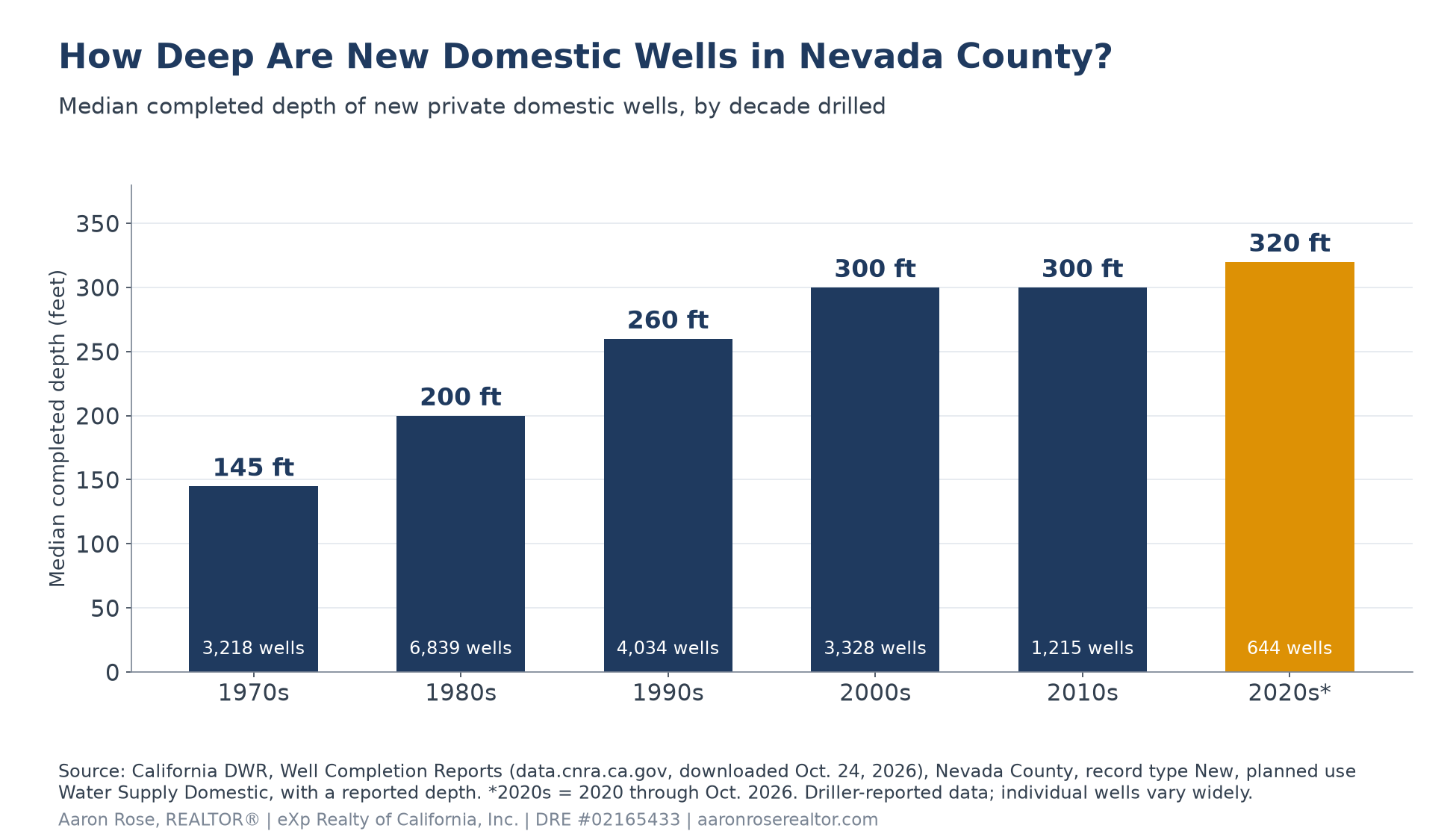
| Decade | Wells with a reported depth | Median depth | Middle half of wells |
|---|---|---|---|
| 1970s | 3,218 | 145 ft | 100 to 205 ft |
| 1980s | 6,839 | 200 ft | 125 to 300 ft |
| 1990s | 4,034 | 260 ft | 140 to 400 ft |
| 2000s | 3,328 | 300 ft | 174 to 500 ft |
| 2010s | 1,215 | 300 ft | 200 to 500 ft |
| 2020 to Oct. 2026 | 644 | 320 ft | 200 to 500 ft |
Since 2000, the middle half of new domestic wells were between 180 and 500 feet deep, and the median static water level drillers recorded was 60 feet below the surface. These are countywide numbers, including the Truckee area, so a specific well can be very different. The well’s own completion report, if one is on file, is the best record of how it was built.
How Do I Find the Well Log for a Property?
Ask the seller first. Well completion reports are also filed with DWR, and its well completion report data can be searched by county and location. Owners can request their own well’s report from DWR. Many older wells, especially those drilled before the 1970s, have thin records, which is one more reason to test the well itself.
What Does Nevada County Require for Wells and Septic Systems?
Nevada County Environmental Health permits new wells and septic systems and sets standards for new homes. Here is what its Private Residential Wells page requires before a well is hooked up to a new residence:
- Raw water certification: a water sample, free of total and fecal coliform bacteria, analyzed by a state-accredited lab, plus a visual inspection of the well before final occupancy.
- Well yield test: a four-hour pump test showing the well can sustain at least 3 gallons per minute. The ordinance allows as little as 1 gallon per minute with a minimum 1,000-gallon holding tank.
- Wellhead inspection: a signed report by a qualified professional on cracks, missing caps, flooding, animal enclosures within 100 feet and hazardous materials near the wellhead.
The same page says Nevada County Environmental Health does not monitor groundwater levels or limit how much water is pumped from private wells. Neither the county’s well page nor its septic page lists an inspection that is required when an existing home is sold, so the testing during escrow is the buyer’s job.
The county’s fees for 2026, from its well and septic pages, give you a sense of what permit work costs if the well or septic system needs changes:
| Permit or service | County fee |
|---|---|
| Raw water certification | $243.58 |
| Residential well permit (new well) | $719.98 |
| Well reconstruction, with inspection | $481.58 |
| Well destruction | $600.88 |
| Standard septic system permit (gravity flow) | $743.50 |
| Non-standard septic permit (pressure dose, pumped and similar) | $866.30 |
| Non-standard treatment septic permit (sand filter, mound, drip and similar) | $989.10 |
| Septic repair permit | $497.90 |
| Septic tank replacement only | $497.90 |
| On-site soils evaluation (OSSE) application | $866.30 |
| Annual maintenance and monitoring permit (pressure dose and treatment systems) | $122.80 |
These are county permit fees only. Drilling, pumps, tanks, leach lines and contractor labor are separate and are usually the bigger part of the cost.
What Well Tests Should I Order When Buying a Home?
Well Flow (Yield) Test
A flow test pumps the well for several hours to see whether it keeps up. Ask for a test modeled on the county’s four-hour standard so you can compare the result with the 3 gpm benchmark. In DWR’s records for new domestic wells drilled since 2000, the median driller-reported yield was 12 gallons per minute, but 11.1% (388 of 3,510 wells with a reported yield) came in under 3 gpm.
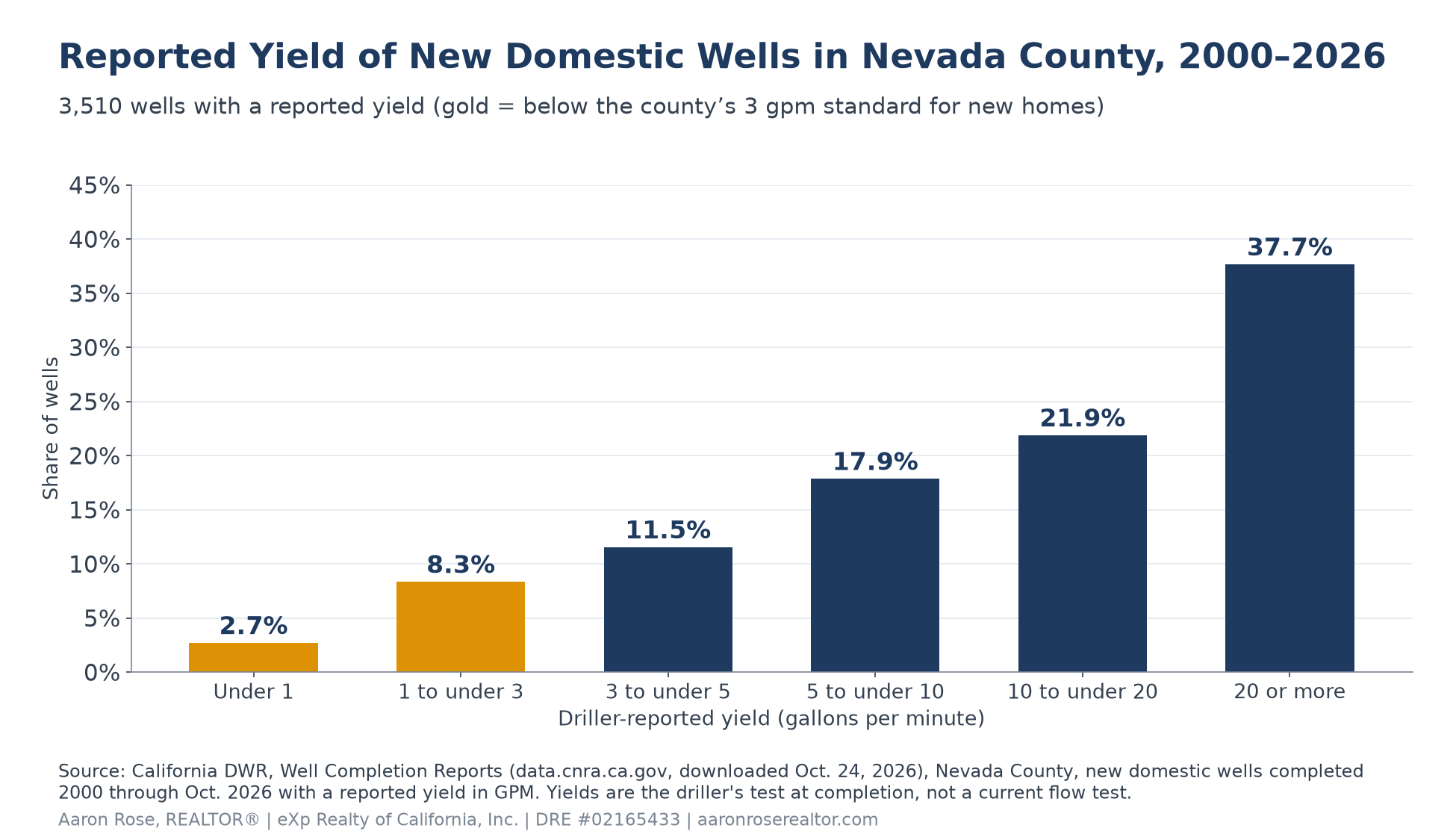
| Yield (gallons per minute) | Wells | Share |
|---|---|---|
| Under 1 | 95 | 2.7% |
| 1 to under 3 | 293 | 8.3% |
| 3 to under 5 | 405 | 11.5% |
| 5 to under 10 | 627 | 17.9% |
| 10 to under 20 | 768 | 21.9% |
| 20 or more | 1,322 | 37.7% |
A yield recorded the day a well was drilled is not a current flow test. Wells can change with drought, nearby pumping and age, so test the well you are buying.
Water Quality Test
Use a lab on the State Water Board’s list of accredited laboratories. The Board’s domestic well fact sheet suggests:
- Every year: total coliform bacteria (and E. coli if coliform is found), nitrate, and total dissolved solids (electrical conductivity).
- Every five to ten years: trace metals, including arsenic, lead and manganese, and general minerals.
- Near gas stations, auto shops, landfills or industry: VOCs, metals and petroleum hydrocarbons.
- Near farms and livestock: pesticides.
- Any time the water’s taste, color, odor or conductivity changes.
The fact sheet puts basic well testing at about $100 to $400 per well, depending on how many chemicals are tested. The Board’s Guide for Private Domestic Well Owners explains how to read results against drinking water standards. When you buy, the full panel (bacteria, nitrate, TDS and metals) is a smart baseline.
Wellhead and Equipment Check
Have a well professional look at the well cap and seal, the pump, the pressure tank, any storage tank, treatment equipment and the electrical connections. Ask how old the pump is and whether there are service records.
What Septic Inspections Should I Get in Nevada County?
Start with the county file. The Nevada County septic page says the best way to locate a system is the septic as-built, which shows the exact location of the system after installation. If the seller does not have it, file a public records request with Environmental Health for the parcel. The county notes some older parcels do not have complete records.
- Septic inspection with pumping: a qualified septic contractor opens and pumps the tank, checks baffles, lids and any pump, and looks over the leach field area for wet spots or odors.
- Know the system type: a standard gravity system is the simplest. Pressure-dose and treatment systems (sand filter, mound, drip and similar) must be monitored every year by a certified septic service provider, with a recorded maintenance agreement and an annual permit.
- Match the bedrooms: septic systems in Nevada County are sized by the number of bedrooms and the soil percolation rate, according to the county’s standard septic installation guide. If the house has more bedrooms than the permit, ask questions.
- Think about future plans: an addition, ADU or pool can bump into the leach field or its required repair area. The county’s septic rules require a 100% replacement area on new system site plans.
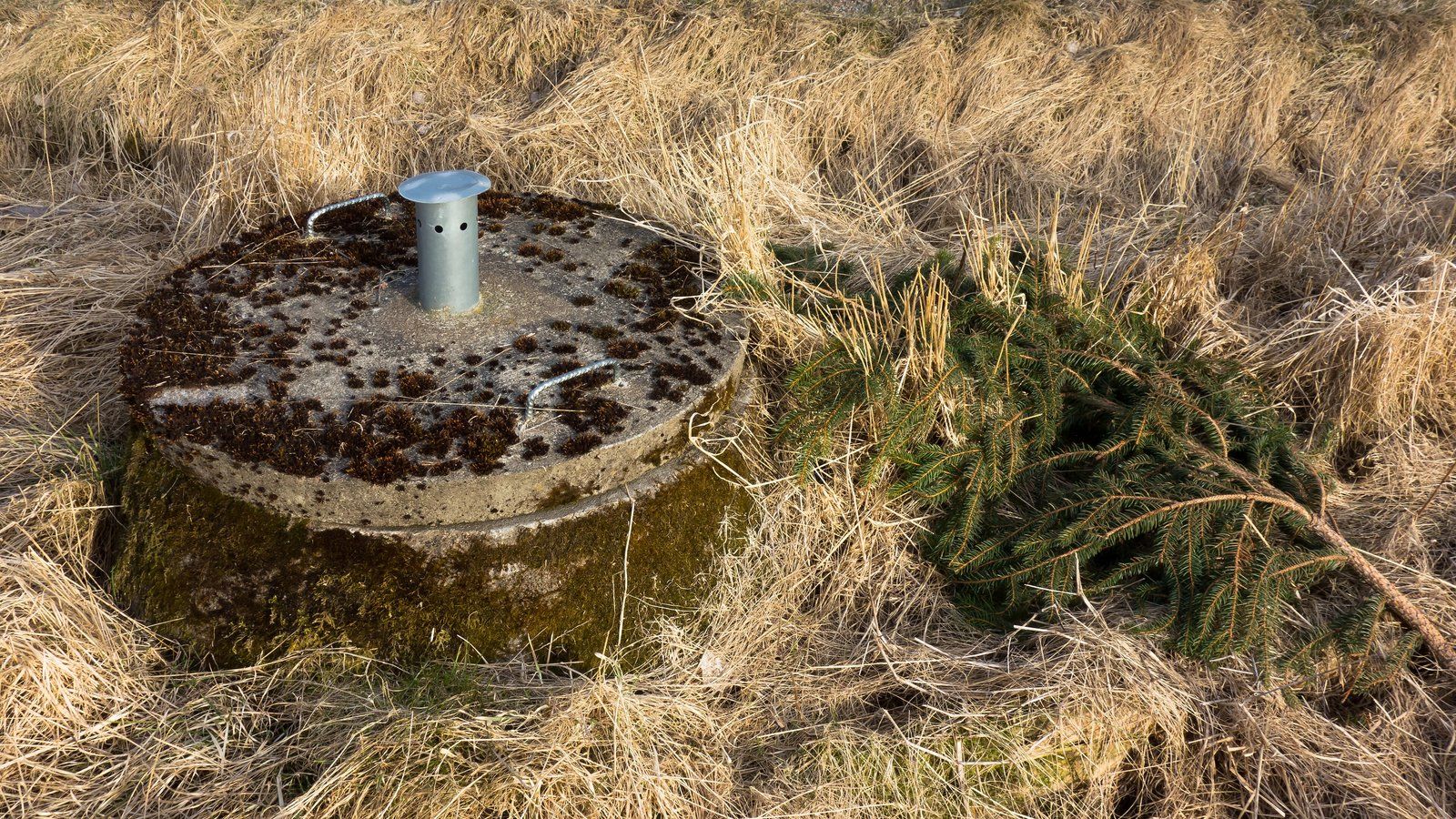
Septic work needs a permit. Under the county’s septic rules and its Local Agency Management Program (LAMP) for onsite wastewater systems, a permit is needed to install, replace, repair, abandon or change a system, and the work must be done by a licensed contractor (Class A, C-36 or C-42) or the owner.
Well vs. NID Treated Water: What’s the Difference?
Many western Nevada County homes get treated drinking water from the Nevada Irrigation District instead of a well. NID’s 2026 rate schedule for an inside-district treated water customer with a standard 5/8-inch meter is:
| Charge | 2026 rate |
|---|---|
| Monthly fixed service charge (5/8-inch meter) | $29.33 |
| Water use, first 5 HCF per billing period | $2.42 per HCF |
| Water use, over 5 HCF per billing period | $3.13 per HCF |
| State and county mandated fee | $1.90 |
One HCF is 100 cubic feet, about 748 gallons. On August 6, 2026, the NID Board approved a 9% increase in treated and irrigation water rates for 2027. NID estimates a treated water customer with a 5/8-inch meter using 5 HCF a month will pay about $3.90 more per month.
- Well: no water bill, but you pay for the electricity to run the pump, testing, and repairs to the pump, tank and well. Supply depends on that one well.
- NID treated water: a monthly bill, but the district treats and tests the water and maintains the system up to the meter.
- NID irrigation (raw or ditch) water: NID’s water service rules define raw water as water that has not been processed and is not safe for human consumption. Use of raw water for drinking and cooking is excluded unless it is processed by an approved home treatment facility, and NID does not accept new raw water applications for residential use.
If a property has NID irrigation service, ask how many miner’s inches it gets, which season, and whether the ditch crosses neighbors’ land. Confirm every water source in writing before you remove contingencies.
How Do I Protect Myself in the Purchase Contract?
- Use the investigation contingency. The standard California purchase agreement gives you a set number of days (17 unless you negotiate otherwise) to complete inspections. Book the well and septic contractors on day one, since lab results can take several business days.
- Read the disclosures. California’s Transfer Disclosure Statement asks the seller to note whether the home has a septic tank, a sewer connection and a well water supply, and to disclose known defects.
- Ask for records: the well completion report, any past water tests and flow tests, pump and tank service records, the septic as-built and pumping receipts.
- Negotiate on facts. If a test shows low flow, bacteria or a failing leach field, you can ask for repairs, a credit or a price change, or cancel within your contingency period.
- Talk to your insurer and lender early. Ask whether they have any well or septic requirements for the loan or policy.
What This Means If You Want to Buy
A well and septic home can be a great fit. Just budget the time and money to check both systems.
- Book three inspections: a well flow test, a water quality test from an accredited lab, and a septic inspection with pumping.
- Pull the county septic file and the DWR well completion report as early as you can.
- Match the system to your plans: more bedrooms, an ADU or a big garden all affect the septic and the water you need.
- Know your water source: well, NID treated water or NID irrigation water, and what each costs.
- Ask me for help. Talk to me at 530-755-8479, or text me, and I’ll help you plan inspections on the homes you like.
What This Means If You Want to Sell
Buyers of rural Nevada County homes will ask about the well and septic, so get ahead of it.
- Gather records now: the well log, recent water tests, pump service and septic pumping receipts, and the county as-built.
- Consider pre-listing tests. A recent flow test and water test can answer buyer questions before they become repair requests.
- Disclose what you know. California sellers must disclose known problems with the well and septic system.
FAQ: Buying a Home with a Well and Septic in Nevada County
Does Nevada County require a well or septic inspection when a home sells?
Not according to the county’s well and septic pages. Nevada County Environmental Health sets testing rules for wells serving new homes and permits septic work, but it lists no inspection required at resale. Buyers should order their own well and septic inspections during escrow.
How deep are wells in Nevada County?
Often several hundred feet. Based on DWR well completion reports, the median new domestic well drilled in Nevada County since 2000 was about 300 feet deep, and the middle half were between 180 and 500 feet. Individual wells vary widely.
What is the minimum well flow for a house in Nevada County?
For a new residence, the county requires a four-hour pump test showing at least 3 gallons per minute. It can approve as little as 1 gallon per minute with a minimum 1,000-gallon holding tank.
What should I test well water for when buying a house?
Start with total coliform bacteria, nitrate and total dissolved solids, which the State Water Board suggests testing every year. Add trace metals such as arsenic, lead and manganese, which the Board suggests every five to ten years, and more tests if the well is near farms or fuel sites.
How much does a well water test cost in California?
Basic testing runs about $100 to $400 per well, according to the State Water Board, depending on how many chemicals are tested. Nevada County charges $243.58 for its raw water certification on new homes.
How do I find where the septic system is on a Nevada County property?
Get the septic as-built. Nevada County Environmental Health says the as-built shows the exact location of the system, and you can file a public records request for the parcel’s file if the seller does not have it.
Can I drink NID ditch water?
No, not untreated. NID defines raw water as water that has not been processed and is not safe for human consumption, and its rules exclude raw water for drinking and cooking unless it is processed by an approved home treatment facility.
How much is NID treated water per month?
For 2026, an inside-district home with a 5/8-inch meter pays a $29.33 monthly fixed charge plus $2.42 per HCF for the first 5 HCF and $3.13 per HCF above that, plus a $1.90 state and county fee. NID approved a 9% increase for 2027.
Sources
- Nevada County Environmental Health: Private Residential Wells (requirements and fees)
- Nevada County Environmental Health: Septic System (as-builts, monitoring and fees)
- Nevada County Environmental Health: Installation Guide for Standard Septic Systems
- Nevada County: Local Agency Management Program for Onsite Wastewater Treatment Systems
- California Department of Water Resources: Well Completion Reports (data downloaded October 24, 2026)
- California State Water Resources Control Board: Domestic Well Fact Sheet
- California State Water Resources Control Board: A Guide for Private Domestic Well Owners
- California State Water Resources Control Board: Accredited Laboratories (ELAP)
- Nevada Irrigation District: Schedule of Rates and Charges, 2026
- Nevada Irrigation District: Water Rates and 2027 Rate Adjustment
- Nevada Irrigation District: Water Service Rules and Regulations, 2026
- California Civil Code 1102.6 (Real Estate Transfer Disclosure Statement)
Last updated October 24, 2026 by Aaron Rose, REALTOR®, DRE #02165433, eXp Realty of California, Inc. (broker DRE #01878277). Equal Housing Opportunity. This article is general information, not legal, engineering or health advice. Well statistics are countywide figures calculated from driller-reported DWR records and do not describe any specific property. Confirm the condition of a specific well and septic system with licensed well and septic professionals, an accredited laboratory and Nevada County Environmental Health.
Ready to talk through your next step?
Whether you are looking at a few acres in Penn Valley or a home in the pines near Nevada City, knowing the well and septic story helps you buy with confidence.
Recent Posts



GET MORE INFORMATION

Agent License ID: 02165433